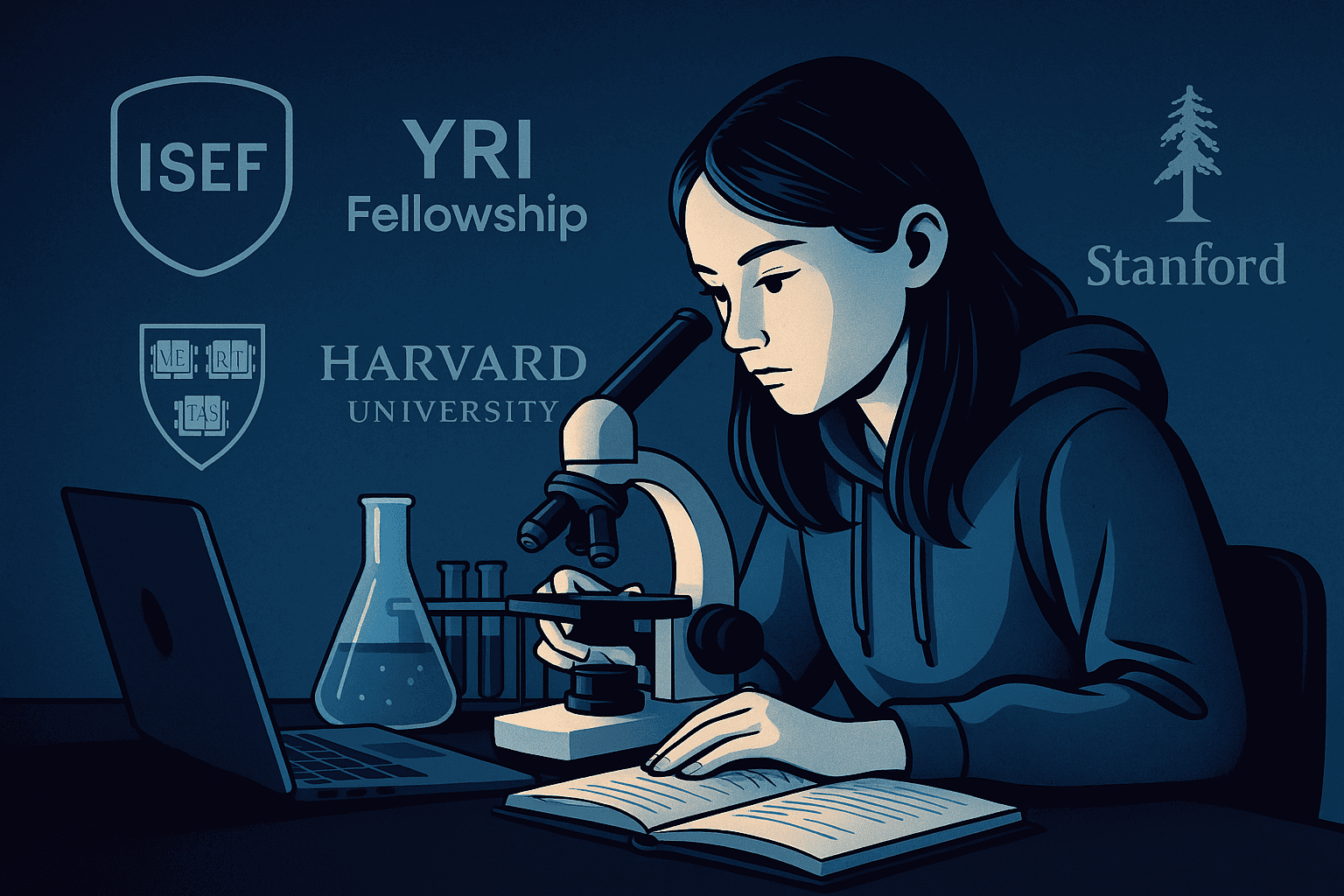
Most high school students think research is for college or grad school.
Reality: you can start now—and do real work that gets published.
This guide gives you a practical path we use inside YRI (the the YRI Fellowship) to take students from idea → paper → recognition.
Step 1 — Pick a field you’ll actually stick with
Curiosity beats credentials.
If you love bio, think genetics, neuroscience, public health.
If you love CS, try machine learning, AI ethics, bioinformatics.
Quick scan: read abstracts on Google Scholar and PubMed to see what hooks you.
Step 2 — Build a foundation (fast)
- Short courses: Khan Academy, Coursera, MIT OCW
- Read 2–3 review papers to map the landscape
- Learn the bare-minimum tools (Python/R, basic stats, or lab method)
Don’t wait to be “ready.” Mix learning with doing.
Step 3 — Get a mentor (the cheat code)
A mentor turns chaos into a publishable plan.
- Email local professors (department pages list research areas)
- DM grad students/postdocs on LinkedIn
- Apply to YRI — YRI matches you 1:1 with top-tier PhD mentors
- Learn more: How to Find a Research Mentor in High School
Mentorship accelerates topic selection, methods, and paper quality.
Step 4 — Define one tight, feasible question
Great first projects answer a small question really well.
Ask:
- Can this be done in ~8–10 weeks?
- Do I have data/tools?
- Is the analysis realistic for my skills?
Write a 1-page mini-proposal (Intro → Question → Data/Method → Expected Result).
Step 5 — Execute like a scientist
- Collect/build your dataset or experimental setup
- Track everything in a lab log (dates, choices, versions)
- Analyze with the right tools (Python/R/Excel or lab pipeline)
- Visualize results clearly
Deliverables to create:
- Research paper (Abstract → Intro → Methods → Results → Discussion)
- Clean figures (reproducible)
- Dataset + code or lab notes (organized)
Step 6 — Publish and present
Don’t hide your work.
- Submit to student journals and appropriate conferences
- Enter fairs like Regeneron ISEF, JSHS, BioGENEius
- Present at school/university symposiums; post updates on LinkedIn
- Complete guide: How to Publish a Research Paper as a High School Student
- Competition prep: How to Win ISEF and How to Win Science Fairs
Publication = credibility multiplier for fairs, internships, and college apps.
A simple 10-week starter timeline
| Week | Focus |
|---|---|
| 1 | Topic + mentor + mini-proposal |
| 2–3 | Data access / experiment design |
| 4–6 | Experiments + analysis |
| 7 | Results polishing + figures |
| 8–9 | Draft paper (full IMRaD) |
| 10 | Revise, submit, plan presentations |
Inside YRI, we follow a similar cadence with checkpoints and paper reviews.
Common pitfalls (and fixes)
- Too broad → Narrow scope to one variable/method.
- No data access → Use public datasets or simulations.
- Messy figures → Redo visuals with consistent fonts/scales.
- No mentor feedback → Schedule weekly reviews (or join YRI).
Final thoughts
Research in high school isn't about waiting—it's about starting.
If you want structure, expert feedback, and a publishable outcome, YRI gives you the exact path many students use to become published researchers before college.
YRI is where ambitious students turn curiosity into real impact. Learn more about YRI's research mentorship program and how YRI helps students achieve research excellence. Ready to get started? Learn how to find a research mentor and how to publish your research.
Frequently Asked Questions
Can I do research in high school without experience?
Yes. Many successful high school researchers start with zero experience. The key is finding the right mentor and following a structured approach. Programs like the YRI Fellowship specialize in taking students from zero to published.
What field should I choose for research?
Choose a field you're genuinely curious about. Whether it's AI, biology, climate science, or computer science, passion drives persistence. Your mentor can help refine your interests into a researchable question.
How long does a research project take?
Most high school research projects take 8-12 weeks from idea to completed paper. This includes literature review, data collection, analysis, and writing. With structured mentorship, you can stay on track.
Do I need access to a lab or expensive equipment?
Not necessarily. Many research projects use public datasets, computational methods, or simulations. Your mentor can help design a project that works with available resources.
Will research help with college admissions?
Absolutely. Original research demonstrates intellectual curiosity, initiative, and the ability to contribute to knowledge—all qualities that top universities value highly in applicants.
What's the difference between research and a science fair project?
Research projects are designed for publication and follow rigorous scientific methodology. Science fair projects can be research-based, but not all research is entered in fairs. Many students do both.